


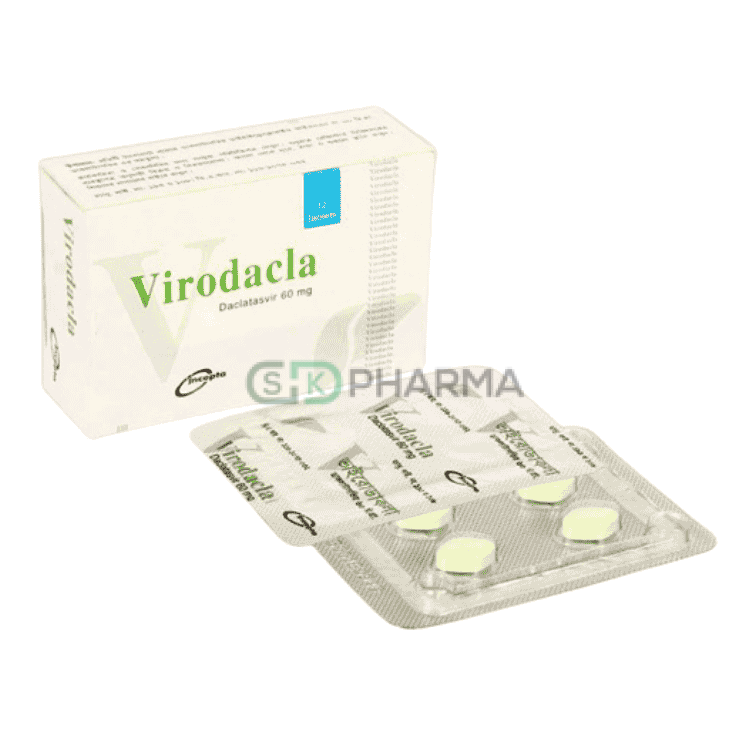
Virodacla Tablet 60 mg (Daclatasvir)
-
 ৳18.80
৳20.00 -
৳3.33
৳3.50 -
৳5.64
৳6.00 -
৳8.46
৳9.00
![Recur Tablet 1 mg (Finasteride [For Androgenic Alopecia])](https://skpharma.com.bd/public/uploads/all/mqB5zpgTubYSB0CMtn0XXhQtwBc22ia6JfYbyrMt.png)

Reviews & Ratings
Virodacla 60 mg Tablet is a direct-acting antiviral (DAA) indicated for the treatment of chronic Hepatitis C Virus (HCV) infection in adults. It is used in combination with Sofosbuvir and, in certain cases, with Ribavirin, depending on the HCV genotype and liver condition. Virodacla 60 mg works by inhibiting the HCV nonstructural protein NS5A, which is essential for viral RNA replication and assembly, effectively reducing viral load and supporting viral eradication.
রেজিস্টার্ড চিকিৎসকের পরামর্শ অনুযায়ী ঔষধ সেবন করুন
Indications
Virodacla 60 mg is indicated for the treatment of:
-
Chronic HCV infection in adults, including:
-
HCV-monoinfected or HCV/HIV coinfected patients
-
Patients without cirrhosis or with compensated (Child-Pugh A) cirrhosis
-
Treatment-naïve patients or those who failed prior therapy with Peginterferon alfa & Ribavirin
-
Virodacla must be administered in combination with other antiviral medications such as Sofosbuvir, with or without Ribavirin, according to HCV genotype and clinical response.
Therapeutic Class
Hepatic Viral Infection Agent / NS5A Inhibitor
Pharmacology
Virodacla 60 mg selectively inhibits HCV NS5A, a viral protein critical for RNA replication and virion assembly. By binding to the N-terminal domain of NS5A, Virodacla prevents viral transcription and translation, thereby halting the HCV life cycle. When combined with other antiviral agents, Virodacla enhances the likelihood of achieving sustained virologic response (SVR).
Dosage and Administration
-
Recommended Dose: 60 mg once daily, orally, with or without food
-
Combination Therapy: Always administered with Sofosbuvir; may include Ribavirin depending on genotype
-
Special Regimens:
-
Genotypes 1, 4, 5, 6 with compensated cirrhosis: 24 weeks or 12 weeks with Ribavirin
-
Genotype 2: 12 weeks with Sofosbuvir
-
Genotype 3: 24 weeks with Sofosbuvir + Ribavirin
-
-
Missed Dose: Take within 20 hours; otherwise, skip and continue next dose
-
Dose Adjustments:
-
Reduce to 30 mg with strong CYP3A4 inhibitors
-
Increase to 90 mg with moderate CYP3A4 inducers
-
Important: Virodacla should never be given as monotherapy, and dose modification is generally not recommended to manage adverse effects.
Drug Interactions
-
CYP3A substrates: Strong inhibitors (e.g., ketoconazole, ritonavir) increase plasma levels; strong inducers (e.g., rifampin, phenytoin, St. John’s Wort) reduce efficacy
-
P-gp, OATP1B1/1B3, BCRP substrates: May have increased systemic exposure
-
Avoid coadministration with drugs that strongly induce CYP3A due to reduced antiviral effect
Contraindications
-
Known hypersensitivity to Virodacla or formulation components
-
Concomitant use with strong CYP3A inducers (e.g., rifampin, phenytoin, carbamazepine, St. John’s Wort)
Side Effects
-
Common: Fatigue, headache, nausea
-
Serious: Symptomatic bradycardia when coadministered with Sofosbuvir and Amiodarone, dizziness, fainting, chest pain, shortness of breath, weakness
-
Patients should be monitored for cardiovascular symptoms if Amiodarone is required
Pregnancy and Lactation
-
Pregnancy: Not recommended in women of childbearing potential not using contraception; continue contraception for 5 weeks post-treatment
-
Lactation: Excretion in human milk unknown; avoid breastfeeding
Precautions and Warnings
-
Monitor for drug interactions that may reduce Virodacla efficacy or increase adverse reactions
-
Cardiac monitoring required when coadministered with Amiodarone
-
Dose adjustment is generally unnecessary in elderly, renal, or hepatic impairment (mild to severe)
Overdose
-
No specific antidote; treat with supportive measures including vital signs monitoring
-
Due to high protein binding (>99%), dialysis is unlikely to remove Virodacla significantly
Storage Conditions
-
Store below 30°C, protected from light
-
Keep out of reach of children
Related Products

Stacor Tablet 20 mg (Atorvastatin Calcium)
Acupain Tablet 10 mg (Ketorolac Tromethamine)


Lamitan Tablet 100 mg (Lasmiditan Hemisuccinate)
Soranix Tablet 200 mg (Sorafenib Tosylate)

Olic Tablet 5 mg (Obeticholic Acid)
Pulfibro Tablet 267 mg (Pirfenidone)

Fexoral Tablet 180 mg (Fexofenadine Hydrochloride)

Flupen Suspension 125 mg/5 ml (Flucloxacillin Sodium)
Product Queries (0)
Login Or Registerto submit your questions to seller
Other Questions
No none asked to seller yet
-
৳18.80
৳20.00 -
৳3.33
৳3.50 -
৳5.64
৳6.00 -
৳8.46
৳9.00


