


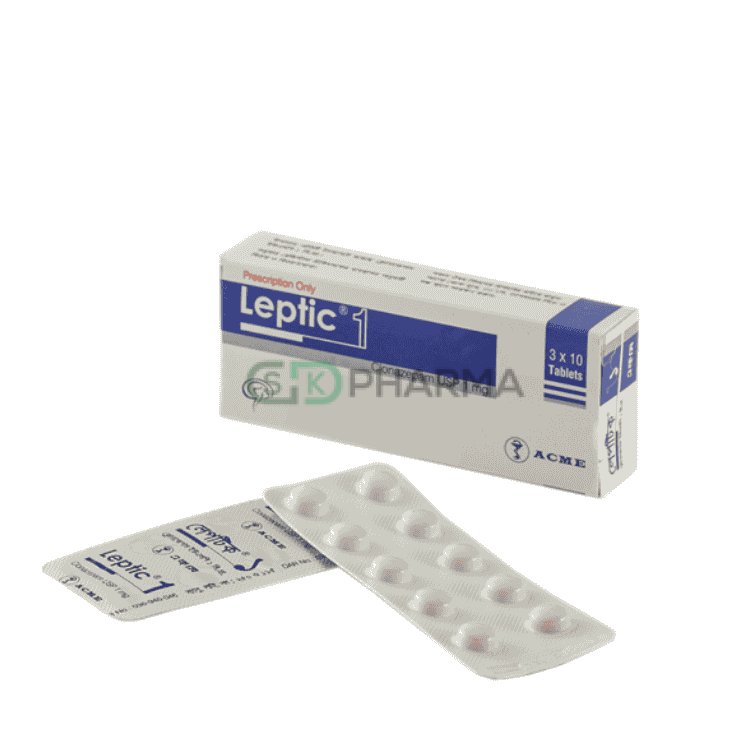
Leptic Tablet 1 mg (Clonazepam)
-
 ৳18.80
৳20.00 -
৳3.33
৳3.50 -
৳5.64
৳6.00 -
৳8.46
৳9.00
![Recur Tablet 1 mg (Finasteride [For Androgenic Alopecia])](https://skpharma.com.bd/public/uploads/all/mqB5zpgTubYSB0CMtn0XXhQtwBc22ia6JfYbyrMt.png)

Reviews & Ratings
Leptic 1 mg contains Clonazepam, a benzodiazepine derivative widely used as an adjunct anti-epileptic and anxiolytic agent. It is primarily indicated for the management of seizure disorders and panic disorder, offering effective control of abnormal electrical activity in the brain. By enhancing inhibitory neurotransmission, Leptic 1 mg helps stabilize neuronal activity and reduce the frequency and severity of seizures and panic attacks.
Leptic 1 mg is commonly prescribed for various forms of epilepsy, including generalized and focal seizures. It is also effective in treating panic disorder, with or without agoraphobia, characterized by recurrent unexpected panic attacks and persistent concern about future episodes.
Although effective, the long-term use of clonazepam, especially beyond 9 weeks for panic disorder, has not been extensively evaluated in controlled clinical trials. Physicians are advised to periodically reassess the necessity and suitability of continued therapy for individual patients.
রেজিস্টার্ড চিকিৎসকের পরামর্শ অনুযায়ী ঔষধ সেবন করুন
Indications
Leptic 1 mg is indicated for:
-
Panic disorder with or without agoraphobia
-
Lennox-Gastaut Syndrome (petit mal variant)
-
Akinetic seizures
-
Myoclonic seizures
-
Absence seizures (petit mal) unresponsive to succinimides
-
Adjunct therapy in generalized and focal epilepsies
Therapeutic Class
Adjunct anti-epileptic drugs
Benzodiazepine hypnotics
Pharmacology
Clonazepam enhances gamma-aminobutyric acid (GABA) activity at inhibitory synapses through positive allosteric modulation of GABA-A receptors. This action increases chloride ion influx into neurons, leading to hyperpolarization and reduced neuronal excitability.
It suppresses spike-and-wave discharges associated with absence seizures and reduces abnormal electrical activity in both generalized and focal epilepsies. Additionally, clonazepam exhibits anticonvulsant, sedative, muscle-relaxant, and anxiolytic properties.
Dosage & Administration
Adults with Seizure Disorders:
-
Start with 1.5 mg daily in three divided doses.
-
Increase by 0.5–1 mg every three days as needed.
-
Maximum dose: 20 mg per day.
Adults with Panic Disorder:
-
Begin with 0.25 mg twice daily.
-
Increase to 1 mg per day after three days if required.
Pediatric Patients:
-
0.01–0.03 mg/kg/day in divided doses.
-
Maximum: 0.05 mg/kg/day.
Injection:
-
Children: 0.5 mg slow IV.
-
Adults: 1 mg slow IV (may repeat up to 1–4 mg).
-
Infusion rate: 0.25–0.5 mg per minute.
-
Maximum total dose: 10 mg.
Contraindications
-
Hypersensitivity to benzodiazepines
-
Significant liver disease
-
Acute narrow-angle glaucoma
Side Effects
Common side effects include:
-
Drowsiness (about 50%)
-
Ataxia (about 30%)
-
Behavioral disturbances (about 25%)
-
Confusion
-
Depression
-
Dizziness
-
Tremor
-
Palpitations
Most effects are related to central nervous system depression and may decrease over time.
Precautions & Warnings
-
May increase the risk of generalized tonic-clonic seizures in some patients.
-
Concomitant use with valproic acid may cause absence status.
-
Use cautiously in elderly patients due to increased sensitivity.
-
Monitor patients with respiratory disorders carefully.
Pregnancy & Lactation
Use during pregnancy only if clearly necessary. Breastfeeding is not recommended during treatment.
Overdose
Symptoms may include drowsiness, ataxia, respiratory depression, hypotension, and coma. Supportive care and monitoring of vital signs are essential. Activated charcoal may be administered if appropriate. Flumazenil may be used cautiously under strict medical supervision.
Storage
Store in a dry place below 30°C, protected from light and heat. Keep out of reach of children.
Leptic 1 mg provides effective seizure control and panic disorder management through enhanced GABAergic activity, supporting improved neurological stability and patient well-being.
Related Products

Consucon MR Tablet 30 mg (Gliclazide)

Topicort Cream 1% (Hydrocortisone Acetate)

Neosten Cream 1% (Clotrimazole (Topical))

Cedril Suspension 125 mg/5 ml (Cefadroxil Monohydrate)
Repotyn Injection 5% (Amino Acid, D-Sorbitol & Electrolytes)
Feelex Tablet 100 mg (Flibanserin)

Lotepro DS Suspension 1% (Loteprednol Etabonate)
![Laxadil Eff. Powder 3.5 gm/5.4 gm (Ispaghula Husk [Psyllium])](https://skpharma.com.bd/public/uploads/all/iaJyqcYUDuWj9EjTeVmlUxM5FdDjj5AcCfpoTvJc.png)
Product Queries (0)
Login Or Registerto submit your questions to seller
Other Questions
No none asked to seller yet
-
৳18.80
৳20.00 -
৳3.33
৳3.50 -
৳5.64
৳6.00 -
৳8.46
৳9.00


