


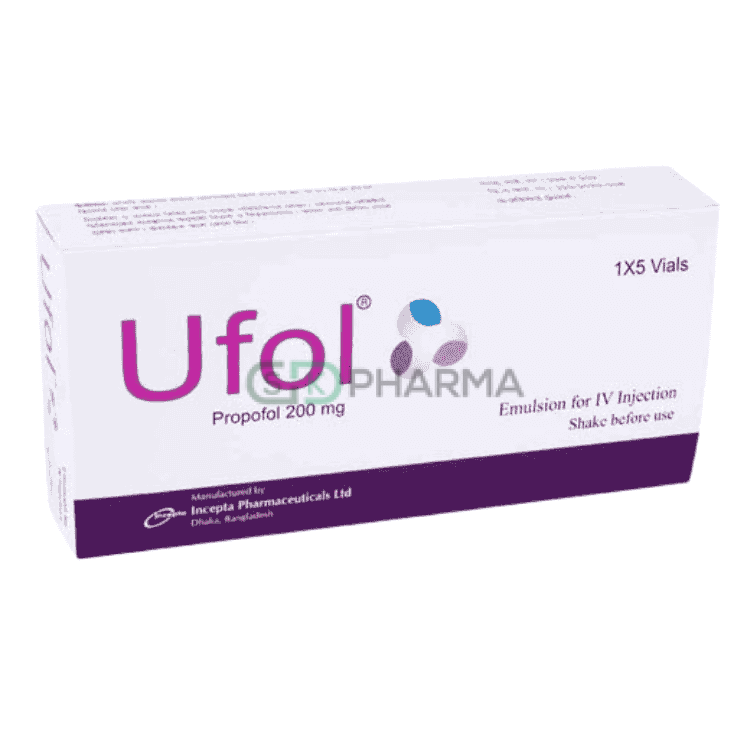
Ufol Emulsion for infusion 200 mg/20 ml (Propofol)
-
 ৳18.80
৳20.00 -
৳3.33
৳3.50 -
৳5.64
৳6.00 -
৳8.46
৳9.00
![Recur Tablet 1 mg (Finasteride [For Androgenic Alopecia])](https://skpharma.com.bd/public/uploads/all/mqB5zpgTubYSB0CMtn0XXhQtwBc22ia6JfYbyrMt.png)

Reviews & Ratings
Indications
Ufol is indicated for:
-
Induction and maintenance of general anesthesia
-
Sedation for diagnostic and surgical procedures
-
Sedation of ventilated patients during intensive care
Pharmacology
Ufol contains Propofol, a short-acting intravenous sedative-hypnotic agent used for the induction and maintenance of anesthesia and for sedation. Propofol acts primarily by enhancing the inhibitory effects of gamma-aminobutyric acid (GABA) at the GABA-A receptor, resulting in rapid hypnosis.
Due to its high lipid solubility, Ufol rapidly crosses the blood–brain barrier, producing anesthesia within 30–60 seconds of administration. Recovery is usually rapid, with minimal residual sedation, confusion, or nausea. Propofol shows minimal accumulation during continuous infusion, making it particularly suitable for prolonged sedation in intensive care settings.
Ufol follows a three-compartment pharmacokinetic model, characterized by rapid distribution, fast metabolic elimination, and a slower terminal elimination phase from poorly perfused tissues. It is extensively metabolized in the liver to inactive glucuronide and sulfate conjugates, which are excreted via urine.
রেজিস্টার্ড চিকিৎসকের পরামর্শ অনুযায়ী ঔষধ সেবন করুন
Dosage and Administration
Dosage should be individualized based on patient response, age, weight, and clinical condition.
Adults
-
Induction: 2.0–2.5 mg/kg by slow IV injection (lower doses for elderly or ASA grade 3–4 patients)
-
Maintenance:
-
Continuous infusion: 4–6 mg/kg/hour (may range up to 12 mg/kg/hour)
-
Bolus injections: 25–50 mg as required
-
Sedation for Procedures or ICU Use
-
Initial bolus: 0.5–2.0 mg/kg
-
Maintenance infusion: 0.3–4 mg/kg/hour
Children
-
Induction (over 3 years): approximately 2.5 mg/kg
-
Maintenance: 9–15 mg/kg/hour
-
Ufol is not recommended for sedation in children or for children under 3 years of age.
Administration must be performed by trained anesthesia professionals using appropriate infusion equipment.
Drug Interactions
Ufol can be used safely with spinal or epidural anesthesia, muscle relaxants, inhalation anesthetics, and analgesics. Concomitant use with opioids may enhance respiratory depression. Lower doses may be sufficient when used alongside local anesthetic techniques.
Contraindications
-
Known hypersensitivity to propofol or any component of the formulation
Side Effects
Common and uncommon adverse effects may include:
-
Pain at injection site
-
Hypotension and transient apnea during induction
-
Headache, nausea, or vomiting during recovery
-
Rarely, convulsions, dystonic reactions, pulmonary edema, or hypersensitivity reactions
-
Long-term use may cause harmless green or reddish-brown discoloration of urine
Pregnancy and Lactation
Ufol is not recommended during pregnancy due to insufficient safety data. It should not be used for obstetric anesthesia. Safety during lactation has not been established.
রেজিস্টার্ড চিকিৎসকের পরামর্শ অনুযায়ী ঔষধ সেবন করুন
Precautions and Warnings
-
Must be administered only by anesthesiology specialists or under their supervision
-
Continuous monitoring of respiratory and cardiovascular status is required
-
Use with caution in patients with cardiac, respiratory, renal, hepatic impairment, or hypovolemia
-
Bradycardia or asystole may occur; anticholinergic premedication may be considered
-
Not a substitute for analgesics; additional pain control is required
-
Full recovery should be confirmed before patient discharge
Use in Special Populations
-
Not recommended for children under 3 years of age
-
Dose adjustments required for elderly and critically ill patients
Overdose
Overdose may cause severe respiratory and cardiovascular depression. Management includes ventilatory support with oxygen and appropriate cardiovascular support measures.
Therapeutic Class
General (Intravenous) Anesthetics
Reconstitution
Ufol should not be mixed with solutions other than 5% dextrose or lidocaine 10 mg/ml injection.
Storage Conditions
Store below 25°C. Do not freeze. Discard any unused portion after opening.
Related Products
Lumiface Cream 0.01% (Trifarotene)
Cortiflu Eye Drop 0.05% (Difluprednate)


Klarix Suspension 125 mg/5 ml (Clarithromycin)

Foly Tablet 15 mg (Folinic Acid)

Tamodex Tablet 10 mg (Tamoxifen Citrate)

![Honeybas Syrup (Herbal cough syrup [Vasakarista])](https://skpharma.com.bd/public/uploads/all/FRxilZajFcBr0AHSwGphVoWiGR4BPoBy4dup0CQr.png)
Honeybas Syrup (Herbal cough syrup [Vasakarista])

Esloric Tablet 300 mg (Allopurinol)

Zemicef Pediatric Drop 25 mg/ml (Cefixime Trihydrate)
Product Queries (0)
Login Or Registerto submit your questions to seller
Other Questions
No none asked to seller yet
-
৳18.80
৳20.00 -
৳3.33
৳3.50 -
৳5.64
৳6.00 -
৳8.46
৳9.00


